
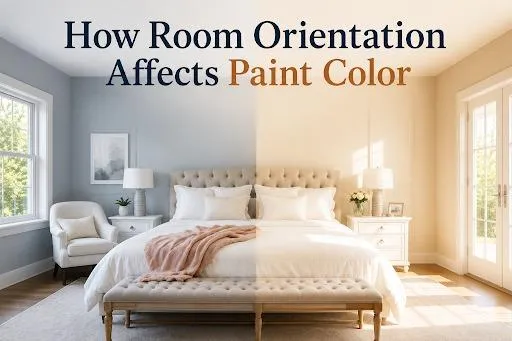
How Room Orientation Affects Paint Color: A Complete Guide
Ever fallen for a paint color at the store, only to get it home and watch it turn cold, dull, or weirdly purple on the wall? The paint didn't betray you. The light did. The direction your windows face matters more than the brand on the can or the furniture in the room. South-facing windows get the most light.
North-facing get the least. East and west split the difference, just at opposite ends of the day. Get the orientation wrong and even a beautiful color falls flat. Get it right and the same shade sings. This guide breaks down all four orientations, the colors that hold up in each, and how to test a color before you waste money on a full gallon.
Which Facing Windows Get the Most Light?
South-facing windows get the most light. The sun tracks across the southern sky all day, so a room with south-facing windows catches steady, strong, warm light from morning until evening. North-facing windows get the least, and their light stays cool and even. East-facing windows get bright, warm light in the morning that fades by afternoon. West-facing windows stay dim early, then get strong golden light late in the day.
So the four orientations rank, most light to least: south, then a tie between east and west (they just get it at opposite ends of the day), then north.
Why South-Facing Rooms Win for Daylight
A south-facing room gets sun for the longest stretch of any orientation. The light arrives warm and full, and because the sun stays on that side of the sky, the room never goes fully shadowed during daylight. That's why builders love putting living rooms, kitchens, and sunrooms on the south side. You get natural warmth in winter and bright, usable light most of the year.
How the Amount of Light Changes How Paint Looks
More light makes a color read lighter and slightly washed out, so a shade that looked rich on the chip can feel pale on a bright south wall. Less light does the opposite: it deepens and mutes a color, which is why a crisp white can turn dingy gray in a dark north room. The volume of light matters as much as its direction, and it's exactly why the same can of paint behaves like two different colors in two different rooms.
How to Tell Which Direction Your Room Faces
You don't need to guess. Stand inside the room and face the largest window. Pull out your phone, open the compass app, and point it at that window. Whichever direction it reads is your room's orientation. No app handy? Watch where the sun comes up. If morning light fills the room, you're facing east. If the room glows late in the day, you're west. Bright all day means south; cool and shadowy all day means north.
The Compass Method (and the Phone Trick)
Every smartphone has a built-in compass, so aim it at your main window and note the reading. For rooms with windows on two walls, point it at the wall with the most or biggest glass, since that's where most of your light comes from. Write the direction down before you start shopping for color. It's the one fact that changes every recommendation that follows, and our team is always happy to walk DIY homeowners through the next steps.
Why the Same Paint Looks Different in Different Rooms
Light has a temperature, and that temperature drags a paint color one way or the other. Cool light, the kind you get from the north or in the early east, pulls colors toward blue and gray and can leave warm tones looking muddy. Warm light from the south or the late-day west does the reverse, pushing colors toward yellow and amber, which makes some cool colors richer and some warm ones go a bit sallow. Then the sun sets, your bulbs come on, and the wall shifts all over again. The paint isn't misbehaving. It's just reflecting whatever light hits it.
Warm vs. Cool Undertones
Every paint color carries an undertone underneath its main color, and that undertone is what reacts to the light. A gray with a blue undertone reads icy in cool north light but balanced in warm south light. A white with a yellow undertone warms up a dim room but can look creamy-to-the-point-of-dingy where light is scarce. Match the undertone to the light: warm undertones to counter cool rooms, cooler undertones to settle down rooms flooded with warm sun.
A Quick Word on LRV
LRV, or Light Reflectance Value, measures how much light a color bounces back, on a scale from 0 (black) to 100 (pure white). High-LRV colors brighten dark rooms; low-LRV colors absorb light and feel cozy or dramatic. It's a genuinely useful number when you're choosing paint for a tricky room, and it deserves more room than we have here, so we cover it in depth in our separate guide to using LRV to pick paint.
Best Paint Colors for North-Facing Rooms
North-facing rooms get the coolest, most consistent light of any orientation, and that light has no warm sun to balance it. Cool colors turn colder here. Blues go icy, grays go flat, and stark whites can look gray and lifeless. The fix is warmth. Reach for colors with warm undertones, or pick a soft white or cream that adds a glow the window won't.
How Color Behaves in North-Facing Light
Because the light never swings warm during the day, whatever undertone you put on the wall gets pushed further in the cool direction. A beige can drift toward gray. A white can lose its crispness and look a little dull. North light shows a color exactly as it is and then some, so this is the orientation where you want to test most carefully.
Warm Neutrals & Whites That Counter the Chill
Benjamin Moore's White Dove is a soft, warm white that stays inviting where harsher whites go cold. Edgecomb Gray gives you a warm greige that reads gray without the chill. Navajo White brings a gentle cream that fills a dim north room with the warmth the sky won't. If you want color rather than a neutral, lean toward warm-based greens and earthy tones, or embrace the cool entirely with a deep, cocooning charcoal or navy for a cozy den or study.
Best Paint Colors for South-Facing Rooms
South-facing rooms are the most forgiving of all. Warm, abundant light flatters nearly every color, so you have the widest range to play with. The one thing to watch: very warm colors can read even warmer here and tip into too-bold territory during peak afternoon sun. Cool tones, on the other hand, settle into a pleasant neutral.
How Color Behaves in South-Facing Light
That generous warm light pushes neutrals warmer and tones down cool colors, so a blue or green that felt chilly elsewhere becomes balanced and calm. Soft south-facing neutrals and gentle cool blues are a reliable bet. If you love a saturated warm hue, sample it and check it at midday, when the sun is strongest, before you commit a whole room to it.
Best Paint Colors for East-Facing Rooms
East-facing rooms get bright, warm light in the morning and cooler, dimmer light by afternoon. The trick is to decide when you actually use the room. A breakfast nook or kitchen lives in that golden morning window, so colors that drink up early light pay off. A room you mostly use in the evening will be working with cooler, flatter light, so plan for that instead.
Making the Most of Morning Light
For a room you enjoy in the morning, warm whites and soft, sunny neutrals feel energizing and glow beautifully in the early light. If you use the space later, adaptable mid-tone neutrals with a hint of green or blue stay calm and restful once the warmth drains away. An all-day room, like a bedroom, does best with a steady neutral that holds up at both ends of the day.
Best Paint Colors for West-Facing Rooms
West-facing rooms flip the east pattern. Mornings are cool and a little flat, and a west-facing space can feel dark and dreary during the morning hours; late afternoons then flood with strong, golden light. Think about the time you spend there. Used mostly in the evening, a west room becomes a showcase for warm, glowing color. Used in the morning, it needs help adding warmth the early hours won't supply.
Embracing the Golden Afternoon Glow
Soft warm tones and gentle plaster-pink or putty shades look their best in late-day western light, and a living or dining room can turn lovely at sunset because of it. The muted, complex pigments in a line like Little Greene's interior paints are especially good at catching that glow. If that strong afternoon glow feels like too much, a cooler neutral tempers it and keeps the room steady through the day. A few colors even shift between cool and warm as the light moves across the room, which is worth knowing: treat it as a feature if you like a little change, or steer around it if you'd rather a color stay put.
Painting Rooms with Two or More Exposures (Dual-Aspect & Corner Rooms)
Plenty of rooms don't fit one tidy direction. Corner rooms, open-plan spaces, and rooms with windows on two or three walls pull light from several directions at once, which most paint guides skip entirely. A southwest-facing room mixes warm afternoon sun with strong daylight. A northwest room stays cool most of the day with a warm push late. The more exposures you add, the more flexibility you get, because conflicting light tends to average out.
Which Exposure Should Win?
Pick the exposure that dominates, either the wall with the most glass or the direction that lights the room when you use it most. A southwest living room you live in during the evening should be treated more like a west room. A northwest bedroom you wake up in should lean toward the cool, north-leaning side. Then test your sample on more than one wall, because a dual-aspect room genuinely shows a color two ways. Balanced neutrals that don't lean hard warm or cool are your safest choice when the light can't make up its mind, and the designers we work with often lean on exactly this approach for tricky open-plan spaces.
Choosing Color for Low-Light & Atlanta Homes
Some rooms barely get natural light at all: interior bathrooms, basements, hallways, north rooms shaded by trees or a neighbor's house. In those spaces your bulbs do most of the work, so choose your color to suit your lighting. Warm bulbs pair with colors you'd pick for a south room; cool white bulbs pair with north-room logic. Higher-LRV colors help by bouncing what little light you have around the room.
Why Testing in Your Own Space Beats Any Chart
Atlanta light has its own habits. Our long, leafy tree canopy filters daylight differently season to season, and the high summer sun versus the low winter sun changes how much reaches your walls and at what angle. A chart written for a studio in another climate can't account for the oak outside your window in Roswell or the way East Cobb afternoon light slants in come November. The only reliable test is the one you run in your own room, on your own wall, at the times of day you actually live there, and a quick color consultation with someone who knows local light can save you a lot of trial and error.
Where to Get Expert Color Help in Atlanta: Test Before You Commit
Once you know your room's direction and the undertone you're after, the last step is simple: see it in your space before you buy a gallon. Stop by in.SIDE.out Paint Centers and grab Benjamin Moore peel-and-stick samples or sample pots, put them on your actual walls, and look at them morning, noon, and night. You can also order online and pick up in store. Light changes everything, and ten minutes of testing saves you a repaint.
If you'd rather not go it alone, our team offers a free in-store color consultation at our Roswell, East Cobb, and Merchants Walk locations. Bring a photo of your room and tell us which way it faces, and we'll help you find a color that works in your light. Planning a bigger project? Ask us about our local painter referral network while you're in.
Frequently Asked Questions
Which direction of windows gets the most light? South-facing windows get the most light. The sun travels across the southern sky all day, so a south-facing room gets steady, warm light from morning to evening. North-facing windows get the least.
What are the best paint colors for north-facing rooms with low light? Choose warm neutrals and soft whites with higher light reflectance so they bounce the limited light around the room. Benjamin Moore's White Dove is a dependable warm white, and Edgecomb Gray works well if you want a warm greige that won't turn cold.
Do east-facing and west-facing rooms need different paint colors? Yes. East rooms get warm light in the morning and cooler light by afternoon, while west rooms are cool in the morning and golden late in the day. Choose your color based on when you use the room most.
What does a north-facing wall mean? A north-facing wall or room is one whose main windows point north. It gets cool, indirect light that stays consistent all day, with no direct sun, which is why warm undertones usually balance it best.
Why does my paint color look different at different times of day? The color temperature of natural light shifts from morning to evening, and your bulbs add their own cast after dark. Those shifts pull a paint color's undertone warmer or cooler, so the same wall can look noticeably different by the hour.